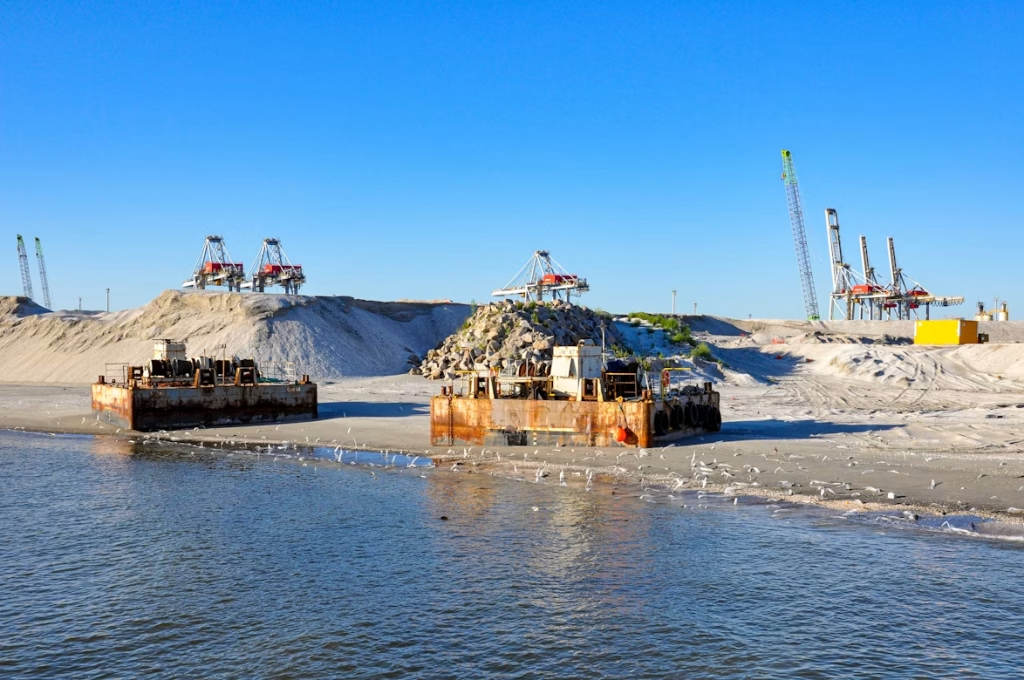
Sandy soil is an unusual construction material. Selecting the right dewatering solutions is critical to maintaining excavation stability in such conditions. When dewatering, stability must be maintained while controlling the inflow of water from groundwater sources and rapid dispersion of water through the sand during excavation. Below, you will find some effective methods of dewatering in sandy soils, strategies for controlling the groundwater lowering as well as professional dewatering solutions that can assist the contractor in seeking to produce stable excavations.
Why Dewatering in Sandy Soils is Challenging?
In regards to construction and excavation of foundations and excavation by dewatering in sandy soils, the soil characteristics directly impact the ability of the work to be successful or unsuccessful.
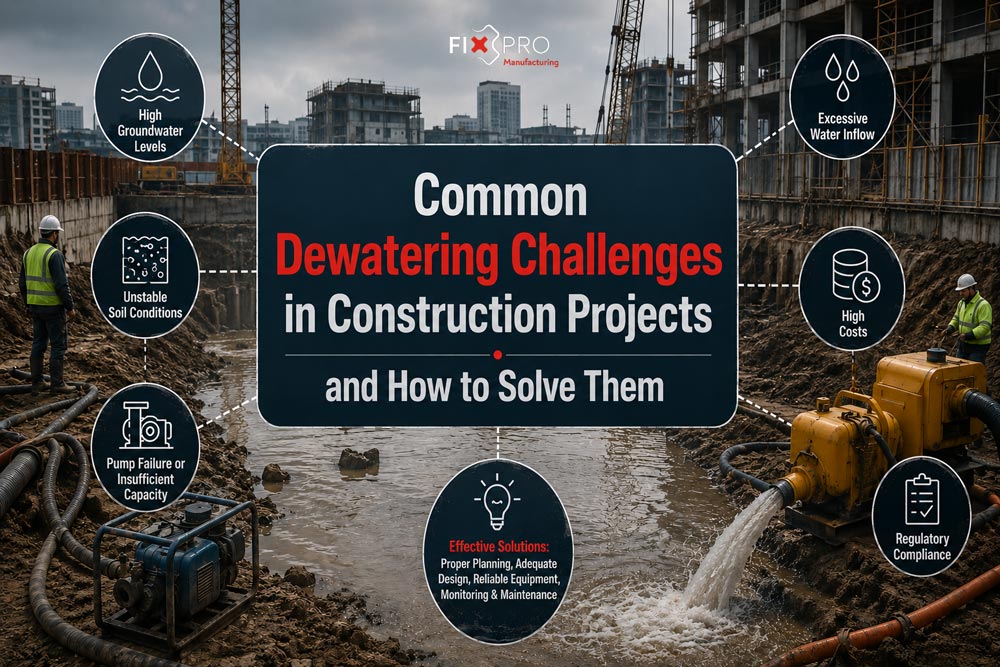
Sandy soils challenges will cause difficulty in controlling the groundwater level at the dewatering construction site. Dewatering challenges sandy soil challenges:
- High permeability: Sandy soils are high permeability soils so water flows quickly through the soil.
- Rapid inflow of water: When excavating in sandy soils, the inflow of water remains continuous throughout the excavation operation due to the continuing recharge of groundwater.
- Increased moisture: The volume of the soil after liquid water has been removed will likely cause the strength of the soil to decrease allowing for precursors to a failure of the excavation.
- Soil instability in sandy soil: Trench sidewalls collapsing due to stabilization of the soil, culture of heaving, or boiling and loss of bearing capacity within saturated sandy soils at the bottom of the excavation are common causes of soil instability.
Example of Sandy Soil Challenges in Pipeline Installation
During the installation of pipelines by trenching, it is often observed that the AWP of the side walls collapse shortly after excavating. This is usually caused by the groundwater being saturated with water and flowing at a very high velocity to the location of the excavation of the pipeline.
Despite constant pumping, the inflow rate may still be too high to handle. It is evident that there are certain drawbacks of traditional dewatering techniques used in construction. Stabilizing and maintaining dry conditions become quite hard to achieve in such cases.
These challenges highlight why traditional dewatering methods are often not sufficient for sandy soil conditions.
Common Dewatering Problems in Sandy Soil
When constructing dewatering systems in sandy soil, there are many types of recurrent issues that arise. These are not separate issues but are interrelated and will often exacerbate one another.
Sand Ingress and Pump Clogging
Traditional style centrifugal pumps tend to wear rapidly due to the abrasiveness caused by the sand. Sand ingress, sand particle entry through groundwater inflow, is one of the major issues; as water flows into the excavation from groundwater, fine grain and coarse grain particles will also enter the water that is being pumped out of the excavation, causing the following:
- Pump clogging .
- Wear of the internal parts on the pumps.
- Loss of efficiency over time.
Pump Inefficiency in Sediment-Laden Water
Standard dewatering pumps are mostly not efficient for soiled waters. In sand soils, water is not clean water at all. Rather it contains dissolved solids and slurry mixtures. Fine sediments subtracts as much as 35% from pump performance and can increase power usage.
As efficiency decreases, contractors must operate systems for longer periods of time, driving up operating costs.
Instability of Trench or Excavation
In deep excavations this instability may develop into safety concerns requiring further shoring or revising the dewatering plan.
- Collapse of the trench wall
- Unsafe working conditions
- Project program delays
Effective Dewatering Methods for Sandy Soil
Sandy soils present unique challenges for construction dewatering methods. The systems outlined below are generally applicable. The design of a dewatering system must take into account site-specific conditions.
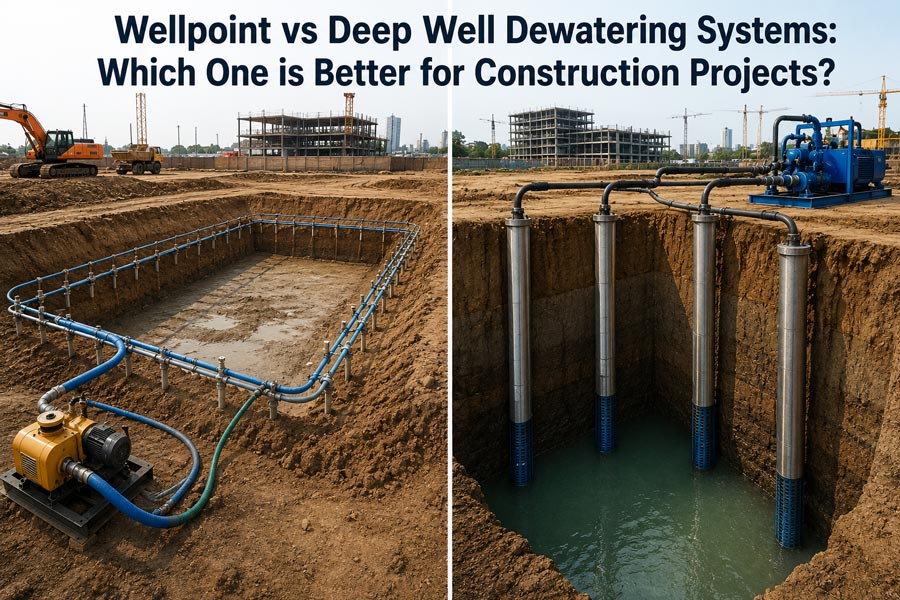
Wellpoint Dewatering Systems
Wellpoint systems can be implemented to dewater shallow trench excavations, trenches that are cut for utility lines, and to dewater diggings in the area of a foundation or footing.
| Advantages | Limitations |
| By using a vacuum, the drawdown of water from a wellpoint is very effective in decomposing through sand | Wellpoints are prone to sand entering the wellpoint causing the wellpoint to become clogged. |
| Flexible installation along the perimeter of a trench excavation | Precise spacing and installation of wellpoints is required for the wellpoint system to function as intended. |
| Appropriate for projects where it is necessary to dewater an aquifer under the trench. | The effective range of wellpoint systems decreases as the excavation becomes deeper. |
Deep Well Dewatering Systems
When there are high water volumes, and difficult conditions associated with dewatering larger excavations, Deep Well Systems could be the proper solution.
| Advantages | Limitations |
| Deep well systems are effective for dewatering larger volumes of water. | Deep well systems have a high degree of sand pumping and will result in wear on the equipment available to pump groundwater. |
| Deep wells provide effective means to dewater the groundwater in high depth excavation. | Deep well systems require a filtration system to keep the sediment laden water flowing to the pumps. |
| Develop a stable drawdown of water from the aquifer under an excavation to provide the greatest possibility to the area of excavation. | The installation costs associated with installing deep well systems tend to be high. |
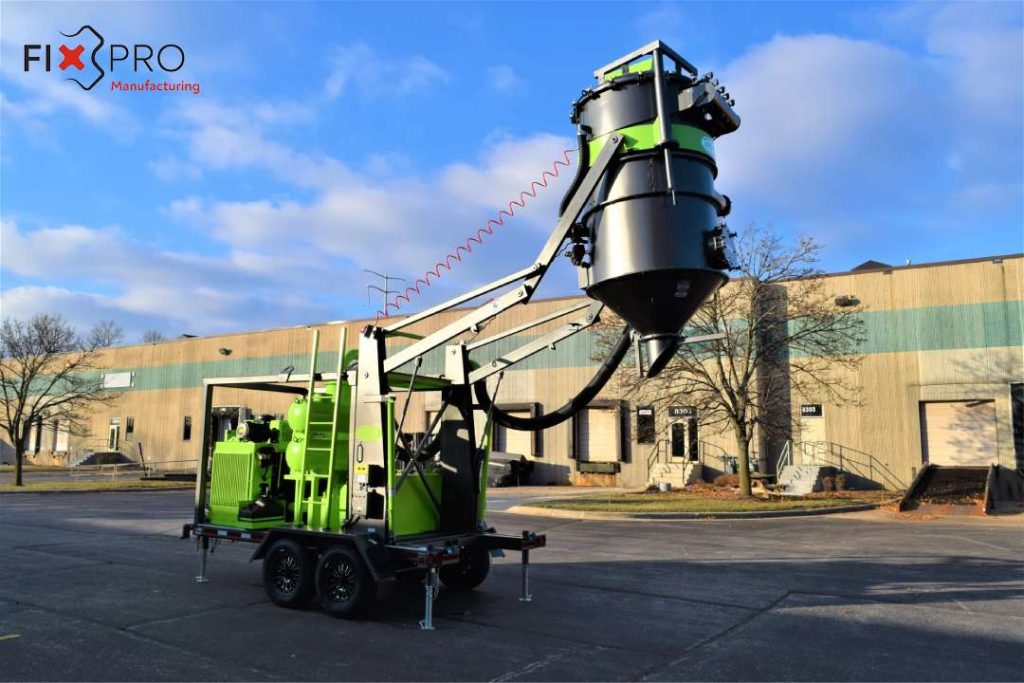
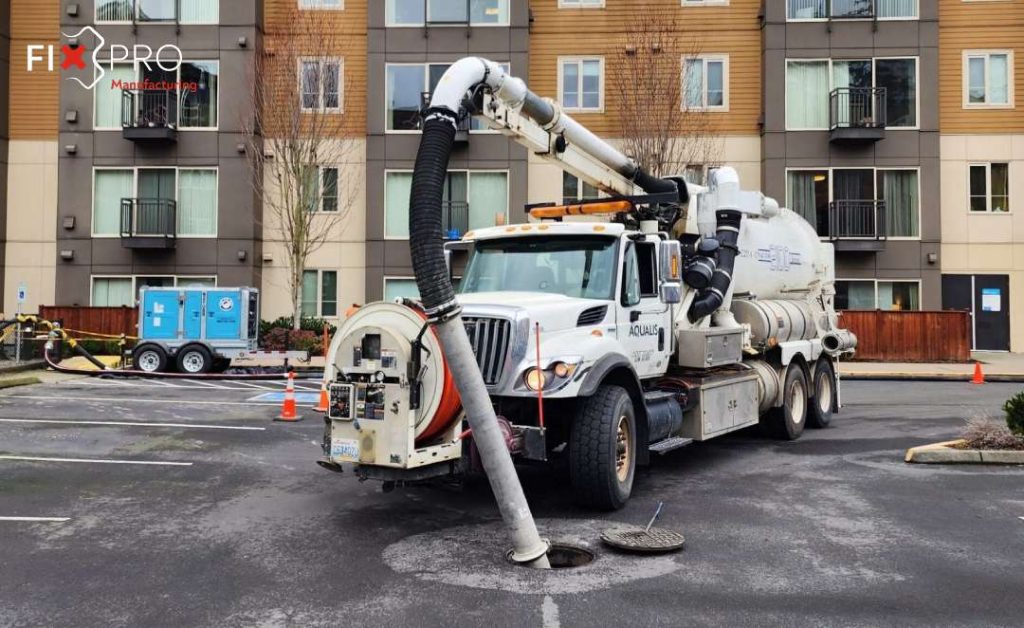
Vacuum-Assisted Dewatering
It is useful for tough conditions, difficult to pump, typically low and sandy to silty or mixed. Also this dewatering method is very low and difficult to pump.
| Advantages | Limitations |
| Meets the acceptance specs on both liquids and solids or sand sludge slurry | Need for specific equipment |
| Drastically reduces the problem of clogging | Higher initial investment than simple pumps |
| Superior even when water is low | – |
| Enhances general effectiveness of ground water management | – |
Limitations of Traditional Dewatering Methods
Although the conventional wellpoints and deep well systems are the most basic and most popular, they are definitely not suitable for dewatering in sandy soils. However, these systems are not suitable for complex dewatering solutions required in high-permeability sand. Here are its limitations:
- Frequent Clogging and Wear: It leads to impeller damage, junction failure, seal failure and more downtime.
- High Maintenance Requirements: Continuous operation in sediment-rich environments requires regular checks, component changeover, more labor and force engagement
- Inefficiency in Sand-Heavy Water : Traditional pumps are made to perform best when running only water; therefore, they are not well suited to work with mixed applications where sand or any other type of additive is present.
- Limited Performance with Low Water Level: As the water level reduces in sand or sandy situations, many pumps will lose efficiency through suction. However, the remaining water mixed with sand still exists, making it very difficult to repair the site.
In these conditions, the performance:
- Is severely reduced to a fraction of the original
- Increases power usage
- Reduces the reliability of the system
Advanced Dewatering Solutions for High-Permeability Sandy Soils
In many construction projects, the conventional dewatering systems stop working before the excavation reaches the intended depth. Sandy soils cause a relentless cycle of groundwater recharge, high seepage pressure, sediment movement, and unstable excavation conditions which standard pumping systems are unable to handle properly most of the time.
Groundwater Flow information are additional options on groundwater management techniques. When groundwater moves very quickly through sand layers permeable to the extent that physical contact with a human is possible, the following situations may arise for contractors:
- Flooding of trench or excavation leading to time loss
- Getting sand into the pumping system continuously
- Cavitation of pump and wear of equipment
- Boiling and heaving of the soil at the excavation base
- Unexpected collapse of excavation
- Delays caused by ongoing repairs and pump replacement
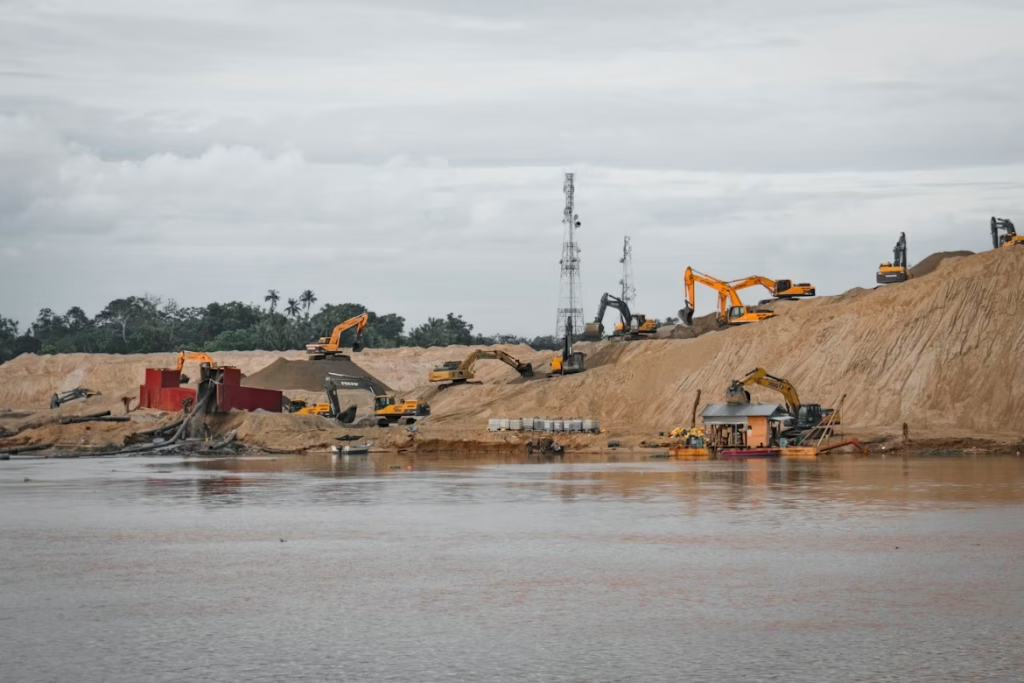
These issues will be multiplied several times if the excavation is deep, marine construction is involved, tunneling is done, infrastructure works are carried out, and foundation projects are executed where groundwater inflow rates can escalate significantly within a short duration.
Conventional dewatering processes like standalone wellpoints or deep wells usually do not hold up stable drawdown in these conditions because they are not intended to operate in environments where there is a lot of sediment and the recharge is high.
Therefore nowadays large-scale construction projects depend more and more on engineered groundwater control systems that incorporate several technologies in a single dewatering strategy.
For complex construction environments such as deep excavations, tunnels, and infrastructure projects, using engineered dewatering solutions in UAE can significantly reduce downtime, improve performance, and ensure project stability.
Modern dewatering solutions can be:
- Vacuum-assisted wellpoint systems
- Hybrid deep well configurations
- Automatic groundwater monitoring systems
- Sand separation and filtration units
- High-efficiency slurry-capable pumps
- Real-time flow and pressure adjustment systems
Best Practices for Groundwater Control in Sandy Soil
Groundwater control in sandy soils requires a different approach than traditional methods to effectively control groundwater.
Assessment of Site and Soil
By understanding the site conditions, the best method(s) can be selected. Additionally, before any systems can be put into place they should consider:
- Permeability tests
- Soil gradation
- Groundwater level and flow direction
Selecting the Right System
There is no single system that will work in every case. Often times, the best results achieved come from :
- Wellpoint systems for shallow control
- Deep wells for bulk water removal
- Vacuum systems in sediment heavy areas
Monitoring the Groundwater
To maintain stability, groundwater must be monitored continuously.
- Use piezometers to determine the water level
- Change pumping rates if required.
- Look for signs of instability for example settlement or fluctuating groundwater level
Control the Sediment and Sand
A major downfall to a lot of projects is the handling of sediment. Adequate systems must ensure:
- No sand enters the pumping systems
- The pump is able to remove all of the slurry and debris that may accumulate.
- The system will continue to operate effectively as time goes on.
Modern Solutions to Dewatering in Sandy Soils
It is often difficult to overcome the problems of dewatering due to high permeability and continuous water seepage in sandy soils. Also, problems related to sand can cause blockages leading to instability in excavation and rising costs of the project.
Engineers engaged in such excavation activities are required to use something more than just conventional pumping systems because such requirements often arise in modern-day projects.
The use of advanced methods of groundwater control and engineering is necessary for ensuring stability of excavation, efficiency, and success in such conditions. Explore professional methods of groundwater control and excavation stability for your project.
FAQ Related to Dewatering in Sandy Soils
What is the best dewatering method for sandy soil?
It will ultimately depend on both the depth of your project and the conditions at your project site.
Why is sandy soil difficult for dewatering?
The permeability of sandy soils is very high; therefore water can move rapidly into sandy soils through the process of hydraulic conductivity. Also, sandy soils are very non-cohesive, therefore there is little to no lateral and vertical support of the soil during the excavation process.
How does groundwater behave in sandy soil?
The high conductivity of sandy material results in a quick movement of groundwater through the soil’s large pore spaces; therefore, controlling groundwater in sandy soils is challenging and requires ongoing dewatering.
What is groundwater control in construction?
Groundwater control during construction refers to the regulation of subsurface water to accomplish safe excavation, maintain stable conditions in the soil, and facilitate efficient construction work.