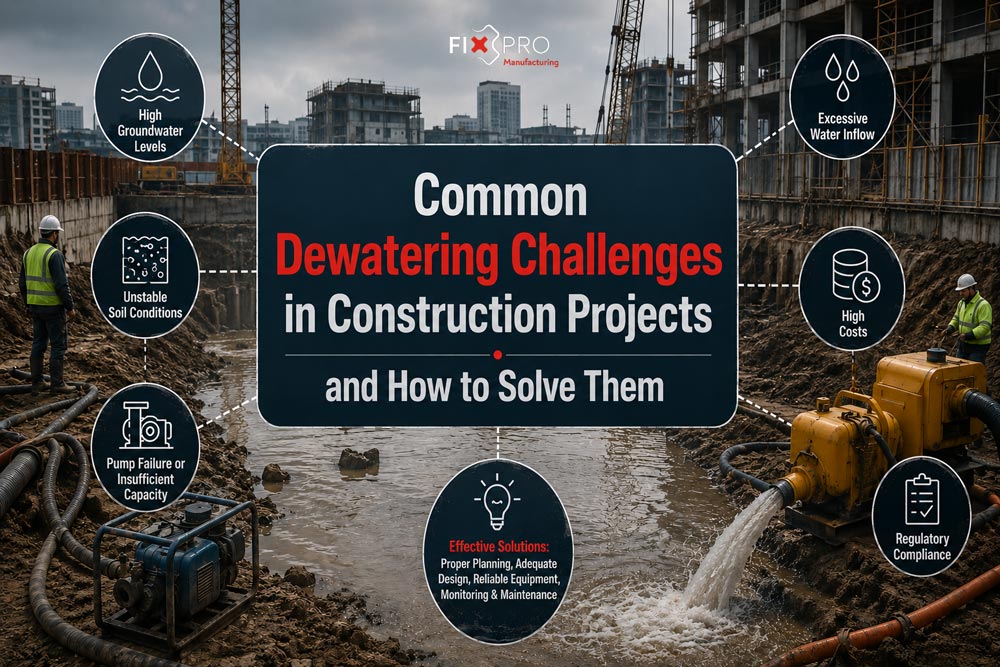
Dewatering challenges are one of the most critical issues in construction projects, especially during excavation and foundation work. From groundwater control problems to pump failures and soil instability, ineffective dewatering can lead to serious delays, safety risks, and cost overruns. Understanding common dewatering problems and using the right solutions helps maintain stable and efficient site conditions. Unexpected dewatering challenges are one of the leading causes of construction delays, budget overruns and risks for structural integrity on projects. The reason that construction dewatering problems are so much more critical is that they rarely occur alone.
This blog will focus on common groundwater control issues during the construction of dewatering projects.
Why Dewatering is Critical in Construction Projects
Groundwater management is a critical part of construction because it directly affects excavation safety, structural stability, and project continuity.Even the best construction plans, when subjected to uncontrolled groundwater conditions, will fail to perform as they should.
During excavation, uncontrolled groundwater can create unsafe working conditions, increase safety risks, and delay deep foundation or basement projects. Furthermore; if groundwater is not adequately managed, it will also greatly reduce efficiency of construction.
Saturated soil can reduce equipment performance, while long-term water exposure may weaken concrete quality. Thus, effective dewatering is mandatory; and represents a key control measure that will:
- Ensure excavation stability
- Allow construction activities to continue in a predictable and safe manner
Most Common Dewatering Challenges in Construction
The following are examples of the most common construction dewatering problems on live projects followed by explanations of how and why they occur.
Clogging Due to Sand and Sediment
Major construction dewatering problems are clogging created from the infiltration of fine grains of sand, silt, and sediment into the dewatering systems. Over time, sediment buildup can restrict water flow and eventually block parts of the dewatering system.
An example of this can be identified in a conventional basement excavation project.Dewatering pumps and wells may work properly at the beginning of a project, but sediment buildup can gradually reduce pumping performance and make groundwater control less reliable.
In one instance, during a basement excavation in sandy soil, the continuous operation pumps that had been designed for continuous operation lost pumping function as early as days after installation.
Clogging due to insufficient filtration at the in-take was the most significant cause of these pump failures.
If sediment is not appropriately managed, clogging leads to an ongoing cycle of increased frequency and reduced reliability in the entire system. The primary factors causing sedimentation in water systems are:
- Ineffective filtering of soil particles entering the system
- Undersized well screen or intake protection
- High groundwater levels move suspended particles into the pump system
Pump Failure and Maintenance Issues
Any construction dewatering project has essentially 2 serious problems caused by pump failure. When the pump fails and the dewatering construction site does not perform correctly, the condition permits groundwater levels to rise quickly.
On a deep excavation project for an underground parking garage, a number of pumps failed repeatedly over a short period of time because they were continuously overworked. The inflow from the groundwater was higher than anticipated, leading to repeated motor burnouts, which resulted in failed systems.
Once one pump fails, the work area can flood in a short period of time creating one of the highest risks associated with loss of productivity. Typical reasons for pump failure:
- Pumps sized incorrectly regarding actual inflow of groundwater
- No preventive maintenance schedule
- Continuous use in abrasive sediment
- No backup pumping system
High Groundwater Inflow
The issue of excess ground water infiltration is the primary cause of ground water control failure and the potential for hydrologic control systems to become overwhelmed by ground water.
If groundwater enters the excavation faster than the system can remove it, the dewatering setup can quickly become overloaded. Heavy rain and nearby construction work can suddenly increase groundwater inflow and lead to flooding inside the excavation area.
An example of this phenomenon is an excavation at the access tunnel to a future utility tunnel, where a sudden influx of ground water, due to an adjacent site performing dewatering operations, caused the ground water level to double in the tunnel.
Because the existing dewatering system was unable to accommodate such an influx of water, the tunnel excavation was temporarily placed on hold. When significant amounts of water are flowing into an excavation, adaptive dewatering measures are necessary and should not rely strictly on fixed capacity systems. Most of the time, the duplicate ground water inflow was due to:
- Inadequate estimation of hydrology at planning.
- Variations in the permeability of the surrounding soil.
- Interference due to the construction activities undertaken by others on adjacent sites.
Inefficiency at Low Water Levels
While most dewatering systems are designed for conditions of significant amounts of ground water inflow, they become inefficient when the level of ground water decreases to an acceptable level.
Low water level inefficiency contributes to energy being wasted, a reduction in the effective pumping of ground water, and unstable ground water control.As groundwater levels drop, pumps sometimes continue operating at full power even when it is no longer necessary, leading to wasted energy and higher operating costs.
For example, with the construction of a multi-level foundation project, even though groundwater levels had reached stability at a reduced elevation, pumps continued to run at 100 percent efficiency resulting in excess energy consumption and increased wear on pump equipment, with no resulting benefit.
Without proper adjustment of the system, as construction progresses, the system becomes inefficient in relation to the current conditions at the construction site. This issue occurs for reasons, such as:
- No adaptation of the system to changing groundwater levels
- Lack of variable control of the pump operation
- No staged dewatering plans conducted during the excavation phase
Soil Instability During Excavation
One of the most hazardous dewatering challenges related to excavated sites is soil instability and the effect of soil instability directly on the structural safety of adjacent structures or improvements.
Soil loses its cohesiveness when ground water is not controlled and can be considered unstable due to an increased potential for collapsing. The most common manifestations of soil instability in deep excavated sites are sidewall sloughs, heave at the bottom of the excavation and deformation of soils in the zone where either the excavation occurred, or soil became unstable.
Once a failure occurs during construction, either will totally stop work on the project or require remedial action to correct the unstable conditions. Soil instability is more than a groundwater issue because it can also threaten excavation safety and disrupt the entire project. There are typically 4 causes of this type of issue:
- Poor pore water pressure reduction
- Lack of knowledge about soil permeability
- Inadequate response times for increased groundwater levels
- Poorly operating dewatering systems
How to Solve Dewatering Challenges in Construction Projects
Attempting to continue with temporary fixes will typically lead to increased costs and numerous additional delays.
The solution to dewatering challenges at construction locations is not simply a matter of utilizing one method or upgrading equipment. Effective dewatering systems are designed to adapt to changing groundwater conditions and reduce the risk of failures before they interrupt excavation work.
All construction dewatering problems require a targeted approach to resolve.
The following are examples of accepted engineering methods that can help resolve dewatering challenges in order to maintain consistency in any given excavation.
Solutions for Clogging Due to Sand and Sediment
The best means of controlling sand and sediment clogging is to eliminate the possibility that sediment can enter into the system from the outset, as opposed to reacting to an event after it has taken place.
One of the best ways to reduce clogging is to use proper filtration systems and well screens that match the soil conditions on-site. The use of multiple-stage filtration systems or gravel pack systems in high sediment-bearing environments can drastically reduce the chance of clogging. Thus, to achieve this, the following strategy is utilized:
- Emphasizing and implementing preventive measures rather than maintenance
- Using the actual soil grain distribution to design filters
- Continuously monitoring the performance of the intake system rather than waiting for it to fail
A Solution for Pump Failure or Maintenance Problems
Continually replacing pumps does not solve pump failures but designing redundancy and operating stability into the system does. This is achieved best by eliminating single-point dependency.
Instead of depending on a single high-capacity pump, many engineers use multiple pumps along with backup units for added reliability. Operation time increased greatly with the installation of a dual-pumping system on a controlled infrastructure project, as pumping operations were able to continue even while one unit was being serviced. Therefore the best way to create an efficient pumping system is:
- Using dual-pumping systems (primary + backup)
- Matching pump capacity to the maximum inflow, not the average design flow
- Scheduling maintenance at regular intervals versus having a repair done only after a failure occurs
- Installing flow or pressure sensors to alert personnel of variations in flow or pressure
Addressing High Groundwater Inflow
Adaptive dewatering methods are needed when there is a high level of groundwater inflow rather than creating fixed-rate dewatering methods. The goal should be to create dewatering systems that shift their design basis as the rate of groundwater movements change.
A staged lowering of groundwater combined with perimeter control will work best, as you are lowering the groundwater in smaller increments with continued stability of the soils under excavation, rather than taking all of the water out at once.
Many engineers will combine perimeter wells and controlled pumps on a phased basis to maintain a balance between inflow and outflow pressures during a deep excavation project. There are several best practices for addressing an increase in groundwater inflow:
- Design staged dewatering phases
- Employ perimeter-based means of intercepting groundwater
- Continuously vary pumping rates based upon actual inflow data
- Perform update hydrogeology model updates prior to construction.
Addressing Pumping at Low Water Levels Inefficiencies
Pumping inefficiencies at low water levels can be addressed by providing for system responsiveness rather than system stability or constant operation of pumps at maximum capacity when they are no longer needed to maintain site conditions.
The most effective method of addressing pumping inefficiencies includes providing variable control systems that enable pumps to adjust pumping intensity to actual groundwater levels for the project.
Various construction projects that include adjustable flow control mechanisms have historically reduced energy consumption and provided for significantly extended life expectancy of equipment. The recommendations for a successful dewatering project are as follows:
- Install variable speed pump control systems.
- Segment staging for dewatering based on excavation depth.
- Use real-time monitoring of groundwater levels.
- Shut down or reduce pump capacity when reaching thresholds.
Solution for Pore Water Pressure Problems
Controlling pore water pressure and maintaining equilibrium of the soil will solve problems associated with unstable soil due to the excavation process, therefore removing water from the area is only part of the solution.
The most effective means to control groundwater is to integrate the ground water dewatering and structural support of the excavation process so that groundwater is controlled simultaneously with the support structure rather than as separate activities.
Controlled dewatering to support structures has been proven on many projects where the combination of the 2 has greatly reduced the potential for movement of the soil or failure of the soil as a result of excavation. Best practices for implementing dewatering techniques on-site are as follows:
- Gradually lower the elevation of the groundwater to avoid creating a large difference in pressure between the excavated area and the groundwater level.
- Combine the use of dewatering of groundwater with the support structure for the excavation.
- Continuously measure soil movement as the groundwater is drawn down.
- Adjust your pumping rates appropriately so that a balance of soil and groundwater is maintained.
Limitations of Conventional Dewatering Methods
Limitations of various dewatering techniques will most likely occur when construction projects are being planned. Although many types of dewatering methods are available, the reality of their consistency and quality at the jobsite may sometimes be unattainable with the conventional dewatering approach, due to outdated assumptions and beliefs regarding the behavior of the soils at the site, along with the lack of any engineering flexibility or control with the conventional dewatering techniques.
Engineering flexibility is crucial when determining how to correctly implement dewatering techniques for construction projects.
Limited Flexibility to Adapt to Changing Ground Conditions
Dewatering systems traditionally are installed according to initial assessments of soil and groundwater. The conditions of excavations can change during construction. Thus, the effectiveness of a dewatering system that was effective initially may not be sufficient if the groundwater level changes or the permeability of the soil changes.
There are many instances where as excavation continues deeper, engineers note acceptable performance levels initially, but as the excavation deepens, patterns of water inflow change from what they originally were and exceed the system’s capacity. This is due to:
- Reliance on pre-construction design assumptions
- Minimal flexibility for making real-time adjustments
- Static approach towards groundwater behavior rather than a dynamic one
Inefficiencies in Complex Soil Conditions
Dewatering systems traditionally perform inefficiently in mixed to highly variable soil. For example, alternating layers of sand, clay, and silt create unpredictable pathways of water movement and make it difficult to control how water moves through a dewatering system.
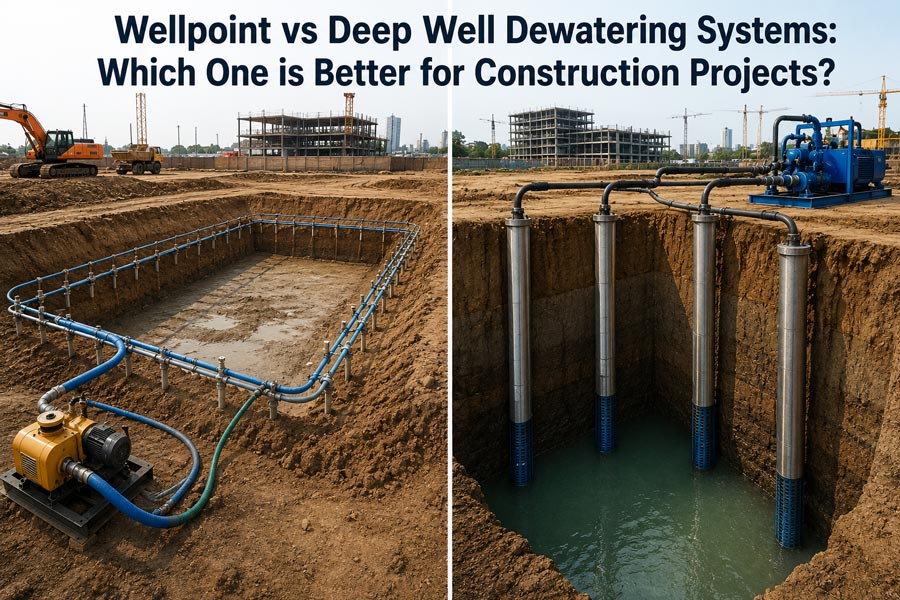
In a real world project where a conventional wellpoint dewatering system was used to dewater a commercial foundation excavation, the wellpoint system worked effectively in the sandy layers; however, once clay pockets were encountered, the wellpoint system was unable to dewater effectively.
This resulted in the accumulation of significant amounts of water in isolated zones of the excavation and resulted in uneven distribution of pressure on the footing. This limitation occurs primarily due to:
- Dewatering system designs are not customized specifically for the soil they are to be installed in
- All dewatering systems are designed uniformly regardless of the difference in the type of soil they are installed in
- Dewatering systems are unable to manage differential permeability in soils between the various layers of soil
High Risk of System Overloading
Traditional dewatering systems may operate close to their maximum allowable hourly throughput when peak inflow occurs. This allows little to no operational headroom, making these systems far more likely to fail in the event of an unanticipated overloading of the system.
An unanticipated inflow can occur at any time due to such things as heavy rains or excavation activities occurring nearby, the result can be catastrophic, as evidenced by temporary flooding of excavation pits resulting in the need for emergency shutdowns on several infrastructure projects. Most often, the underlying traditional dewatering challenges appear to be:
- Capacity planning based on average conditions
- No built-in redundancy
- No real-time performance monitoring
Operational Interruptions Due to Maintenance Dependency
Traditional dewatering systems typically require repetitive manual maintenance to maintain operational status. Therefore, traditional dewatering pumps, filters, and intakes are required to be frequently monitored for both build-up of sludge, debris and to a lesser degree, the continuing stress put on these systems.
Without frequent monitoring of dewatering systems and the condition of their associated components, they will typically deteriorate in terms of efficiency. In summary, failure to maintain traditional dewatering systems will result in the following issues:
- Unexpected downtime when critical excavation dewatering problems are happened
- Higher labor costs associated with the monitoring and servicing of dewatering systems
- Long-term gradual decline in efficiency of dewatering systems
Poor Performance In Long-Term Excavation Projects
The inefficiency of conventional systems during long-term projects is a major limitation that often goes unrecognized. As construction progresses during extended periods of time (from weeks to months), both the hydrogeology and the site’s geometry change.
Conventional systems, however, typically do not accommodate the changes occurring in hydrogeology and the project’s geometry over long-term projects, as they operate from a fixed configuration that does not adapt to changing site conditions. This results in:
- Increased operational costs to operate equipment over an extended period of time
- Decreased level of efficiency to the later stages of excavation
- Increased chances of groundwater re-entry
Advanced Dewatering Solutions for Complex Construction Projects
When conventional dewatering approaches fail to solve your dewatering challenges, the cause of that failure is not simply a failure of operation, but also of design. The missing piece of the dewatering puzzle is solution engineering.
Traditionally, dewatering approaches are created from fixed assumptions such as inflow rates, uniform soil conditions and stable groundwater levels. This means controlling the pressure distribution, the flow paths and stabilizing soil or water interaction throughout the excavation process.
Engineered dewatering solutions are significantly different from traditional dewatering systems, in that they function as an integrated dealer rather than an assortment of separate dealers or pieces of equipment.
In addition, these systems utilize a combination of several different types of controls to respond to circumstances at the job site in real time. Advanced engineered dewatering solutions typically consist of:
- A hybrid (combination) of various dewatering methods selected based on the type of soils being excavated
- Dynamic control of the flow of water through the system based on real-time groundwater data
- Integration of perimeter control and deep control to manage groundwater movement both horizontally and vertically
- Pressure management strategies to minimize pressures that could cause uplift of the entire construction site or destabilized soil
- Redundant or multipurpose systems to ensure that failures are accommodated by backup systems
Best Practices for Effective Groundwater Control
Successful groundwater management does not happen simply by reacting to dewatering problems as they originate; rather it is developed through planning, integrating systems and continuously adjusting to actual field site conditions.
Most construction dewatering problems fail because groundwater management is handled separately as opposed to being included as part of the excavation strategy. The following best practices demonstrate how the experienced site teams maintain stable and predictable excavation conditions in existing construction environments.
Begin With A Thorough Ground Investigatory Effort
Successful groundwater control begins prior to excavating. A thorough understanding of the profile of the soil permeability, and groundwater flow direction is necessary for developing a sustainable system for any excavation project.
Where accurate subsurface soil data is not available to develop dewatering systems, the systems will be designed on anticipated conditions resulting in increased risks of groundwater re-entry.
Plan Your Dewatering Design
One of the most important best practices is planning your dewatering design as part of the overall excavation process. Groundwater control should not be viewed in isolation from the excavation area or method.
By designing the 2 systems in conjunction with each other, pressure distributions, excavating depths and soil/groundwater interactions can be maximized. On large and complex projects, engineers align the stages of dewatering with the phases of excavation to remain in equilibrium and avoid a sudden loss of hydraulic balance.
The above integrated approach is an essential foundation for reliable groundwater control in more complex environments.
Employ Adaptive and Stage Based Dewatering Approaches
Fixed or static systems are a primary cause for escalating dewatering problems when performing construction projects. Groundwater conditions are always changing during excavation, therefore it’s critical that dewatering systems also change to reflect those changes.
Instead of operating at a fixed schedule or flow rate, the majority of successful projects will use a staged dewatering process that will adapt to excavation depth and the behavior of groundwater entering into the construction area. Key concepts are:
- Gradually reducing the groundwater levels
- Adjusting the rate of pumping as groundwater conditions change
- Having regular re-evaluations of system performance at each stage of excavation
Adopt Redundancy in Critical Systems
The chance of system failure is very high during dewatering operations; thus, a single point of failure, such as in pumps or intake systems, can result in flooding of the excavation. Redundancy provides the means for the system to continue working when one of the components of the system fails to work.
By using this method of constructing secondary systems, the risk of downtime during the critical excavation phase of construction is substantially lessened. The best practices with regard to redundancy include:
- Emergency backup pumps available to be activated immediately
- Critical zones have flow lines that allow for parallel flow in the event one flow line fails to operate
- Emergency response protocols for sudden inflow of water
Monitor the Performance
Many failures in dewatering operations develop progressively rather than abruptly. Continuous monitoring enables the engineer to modify the operation as the system’s performance begins to deteriorate. Key areas of monitoring include:
- Variability of groundwater elevations
- Pumps’ fluctuations in flow rates
- Trends in sediment buildup concentrations
- Pressure changes in intake zones
Communicate Between Field Teams and Engineers to Coordinate Decisions
Weak communication between engineers and crews in the field will cause even the most well-designed systems to fail. Groundwater management requires continual coordination between data monitoring and operational decision-making.
Field crews providing timely response to changes in conditions will help to ensure that the smallest issues do not turn into extremely significant construction dewatering issues.
From Dewatering Challenges to Engineered Groundwater Control
When it comes to managing groundwater, there is only one distinction between unstable excavation and controlled progress. This pertains to how the groundwater will be treated, complete removal of the groundwater versus a more integrated and adaptive solution that provides for maintaining stable and efficient conditions through every stage of the construction process.
Changing to the more engineering-oriented process will provide much more than a solution to immediate construction dewatering problems; it will also eliminate or greatly reduce the frequency of recurring failures and will also lead to predictable excavation conditions, reduced downtime; protection of structural integrity from the ground up.
Each construction site will contain different groundwater conditions, and there are many ways to solve groundwater control issues, making it necessary to consider more than just standard approaches to solve dewatering challenges.
If you are facing persistent dewatering challenges on your construction site, working with experienced dewatering contractors and solution providers can significantly improve project stability and performance.
Dewatering FAQ’s Every Site Engineer Needs To Know
What are common dewatering challenges?
The common types of problems with dewatering are: sediment clogging, pump failure due to mechanical failure or pump design failure, high inflow rates of groundwater into the excavation, and at low pumping water levels inefficient performance from pumping equipment, and instability of the excavated soils during the excavation process. Most of the time these problems can occur in combination and can lead to significant construction dewatering problems in a very short period of time if these challenges are not addressed early.
Why do dewatering systems fail?
The typical reasons for failure of dewatering systems are based on poor initial design assumptions, insufficient flexibility in adapting to changes at the construction site, inadequate maintenance, and lack of backup systems. Most often these types of systems are designed for average site conditions, rather than considering the way groundwater performs during peak flow rates which would lead to overloads and breakdowns.
How to improve dewatering efficiency?
Decreased efficiency results from two main causes, both of which can be remedied if the system is designed utilizing actual data at the site continuously refined throughout construction. The two primary methods are using staged dewatering systems, and ensuring that the pumping capacity of the system will accommodate the peak (rather than average) inflow.
What is groundwater control in construction?
Groundwater Control is defined as the ability to manage the level of subsurface water while maintaining a stable, dry excavation, and safe excavation. Groundwater control involves not only removing water but also controlling hydrostatic pressure and flow patterns, and the interaction of soils during the construction process.
What are some ways to prevent sediment from collecting in a dewatering system?
Prevention starts with proper filtration at the point of entry and proper selection of well screens for the type of soil being processed.
When would you consider upgrading to engineered dewatering systems?
If your project has repeatedly been unsuccessful or if your excavation conditions are unstable, you should begin investigating engineered systems. Additionally, when the cost of operating conventional systems continues to increase, it is likely time to consider engineered systems for continued performance and efficiency.